There is not just one yoga, there is one for you
When someone tells me «"I want to start yoga, but I don't know where to begin."», I always answer the same: «"It depends on what you're looking for."»
Because one of the beautiful things about yoga is that there isn't just one way to practice it; there are different styles of yoga, and their benefits vary. Some styles are more physical, others gentler, more meditative, more dynamic, more energetic… and they are all yoga. If you'd like a comprehensive overview of yoga and its benefits in our city, you can also consult our Complete guide to yoga in Granada.
Sometimes we think yoga is just demanding poses or fast-paced sequences we see on social media, but that's only a small part of it. Each style offers a different path to connect with yourself. Discover yoga styles based on where you are in your life, your energy, your body, and your emotional needs.
Perhaps you are seeking to regain flexibility, Whether you want to calm your mind, strengthen your body, release tension, or simply take some time each week to breathe, there's a style of yoga that can help.
In this article, I'll tell you about the main styles of yoga you can find, explaining their characteristics, their energy, and the benefits they offer. Not so you can choose "the best," but so you can discover... which one resonates with you.
Because in yoga, there are no hierarchies or points for effort. There's only one practice that, when it feels like yours, begins to transform your way of being—body, mind... and life.
Hatha yoga: the balanced foundation
If yoga were a house, Hatha would be the solid foundation upon which many other styles are built. It is one of the oldest and most comprehensive systems, and at the same time one of the most accessible, both for beginners and for those seeking a deep practice without the need for fast-paced movement.
The word «"hatha"» It comes from Sanskrit and unites two opposing but complementary energies:
- «"Ha"» = sun, active energy
- «"Tha"» = moon, passive energy
So Hatha yoga seeks precisely that: the balance between strength and softness, effort and rest, body and mind.
What does a Hatha yoga class consist of?
- The postures (asanas) are held for several breathing cycles, allowing for a deeper connection with each form.
- Alignment, stability and concentration are worked on in each posture.
- Breathing techniques (pranayama) are integrated and often a brief meditation or relaxation at the end.
- The rhythm is more leisurely, allowing you to feel and adjust without rushing.
Main benefits:
- Improves flexibility and strength progressively
- Helps calm the mind and reduce stress
- Increases body awareness and posture
- It is ideal for beginners or those returning after a period of inactivity.
- Create a solid foundation if you want to explore other, more dynamic styles later.
Who is it for?
For you if…
- You want to get off to a good start with yoga.
- You prefer a slower but no less deep rhythm
- You are interested in connecting with your body without exhausting yourself.
- You are looking for a balanced practice with a comprehensive approach
Vinyasa yoga: fluidity and dynamism in movement
If Hatha is the yoga of mindful pauses, Vinyasa is the yoga of mindful flow. In this style, postures are linked in dynamic sequences guided by the breath, creating a fluid, creative, and vibrant practice.
The word «"vinyasa"» In Sanskrit it means "to place consciously," which reflects the essence of this practice: each movement has a purpose and is coordinated with an inhalation or an exhalation.
What does a Vinyasa yoga class consist of?
- The sequences vary from class to class, so there is no fixed structure (unlike Ashtanga).
- The pace can be gentle or intense, depending on the teacher's approach.
- Breathing is the guide: each transition is done in time with the inhalation or exhalation.
- It usually includes sun salutations, fluid transitions, and a final relaxation.
A Vinyasa class can feel like a kind of moving meditation: the body is activated, the mind is focused, and energy is released.
Main benefits:
- Improves endurance and coordination
- Increases strength, mobility and flexibility
- Develops breathing awareness and mindfulness
- Helps release physical and emotional tension
- It can be adapted to different levels and intensities
Who is it for?
For you if…
- You like to move and sweat, but also connect with your breathing.
- You are looking for a creative, fluid and energetic practice
- You have some previous experience or are curious to explore.
- It helps you more to "do something to calm yourself down" than to stay still from the beginning.
Ashtanga yoga: discipline, structure, and transformation
Ashtanga yoga is a style intense, structured and deeply transformative, both physically and mentally. Created and systematized by Sri K. Pattabhi Jois, it is based on a fixed series of postures which are always practiced in the same order, linked by breath and movement (vinyasa).
The word «"ashtanga"» It literally means "eight limbs," referring to the path of yoga described by Patanjali: a complete system encompassing everything from personal ethics and discipline to meditation and spiritual realization. But here we will focus on Ashtanga as a style of physical practice.
What does an Ashtanga yoga class consist of?
- A practice is carried out established sequence, starting with the First Series (Yoga Chikitsa).
- Each posture is held for five breaths and connects to the next through a transition (vinyasa).
- We work with the ujjayi breathing, the bandhas (energy closures) and the drishti (visual focus point).
- It can be practiced in a group, with verbal guidance, or in a format Mysore, where each person practices at their own pace and the teacher assists individually.
It is a demanding practice, both physically and mentally, but very powerful in terms of self-knowledge, discipline and personal evolution.
Main benefits:
- Improves strength, flexibility and endurance
- Helps develop a solid personal practice
- Stimulates concentration and self-discipline
- Create a deep connection with breathing
- Establish a long-term transformative routine
Who is it for?
For you if…
- You like challenges and you are persistent.
- You are looking for a structured practice, with clear progression
- You are interested in building a personal practice, beyond directed classes
- You are ready for a practice that requires commitment and attention.
Yin yoga: deep stillness for body and mind
In a fast-paced world, Yin yoga is an invitation to stop, to simply let go. beThis style focuses on stillness, listening, and deep work on connective tissue—such as ligaments, fascia, and joints—through passive postures held for several minutes.
Unlike more dynamic styles such as Vinyasa or Ashtanga, where energy is mobilized yang (active), Yin works from the opposite: the soft, the receptive, the inner.
What does a Yin yoga class consist of?
- Postures are practiced on the floor, held for 3 to 7 minutes, without muscular effort.
- Wanted reach deep tissue through gravity and delivery.
- The focus is on observe what arises while holding the posture: sensations, emotions, thoughts.
- It is often supported with items such as cushions, blankets or blocks to facilitate complete rest.
It is a deeply meditative practice, in which the body gradually opens up and the mind learns to be with what is, without running away or wanting to change it.
Main benefits:
- Improves joint mobility and passive flexibility
- Promotes deep relaxation
- Helps release accumulated physical and emotional tension
- Develop patience, introspection and the ability to be in the present
- It is excellent for balancing more active practices or for moments of fatigue.
Who is it for?
For you if…
- You need to stop, let go and connect with yourself from another place
- You want a more meditative practice than a physical one.
- Are you going through times of stress or fatigue?
- You are interested in taking care of your joints and working from the fascia
Restorative yoga: the art of letting go and regenerating
Restorative yoga is a deep rest for a world that demands too much.
More than a physical practice, it's an act of deep self-care. Here, the goal isn't to stretch or strengthen, but truly rest, at such a deep level that the body can release and the nervous system can rest.
Sometimes confused with Yin yoga, but while they share stillness and the use of passive postures, Restorative goes even further in terms of rest and complete support. In each pose, the body is fully supported by props so there is no muscle tension.
What does a Restorative yoga class consist of?
- Blankets, blocks, bolsters, belts and other elements are used to create a feeling of total containment.
- The postures are held between 5 and 20 minutes, in complete immobility.
- It is breathed naturally, sometimes accompanied by guided relaxation techniques or meditation.
- The practice is carried out almost exclusively on the floor, in a completely calm environment (dim lighting, silence, soft music, etc.).
It is ideal for moments of physical, emotional or mental exhaustion, when all we really need is be supported.
Main benefits:
- It deeply relaxes the body and mind
- Improves sleep quality and rest capacity
- It provides support during times of stress, fatigue, or life changes.
- Soothes muscular and emotional tensions
- It promotes a feeling of rest and recovery of the body
Who is it for?
For you if…
- You find it hard to rest even when you have time
- You are experiencing stress or fatigue
- You want a safe and loving space to let go of control
- You are looking for a restorative yoga practice in the most literal sense
Iyengar Yoga: Precision, Alignment, and Body Awareness
Iyengar yoga is the art of precision.
Created by BKS Iyengar, this style is based on a deep understanding of the body's alignment in each posture, combining technical rigor with close attention to detail that transforms the form into an experience of pure awareness.
At first glance, it may seem like a "serious" or even strict style, but it is actually a powerful way to develop strength, stability and body sensitivity, ideal for both new and advanced practitioners who want to refine their practice.
What does an Iyengar yoga class consist of?
- Poses are held for longer than in dynamic styles, allowing adjust them precisely and deepen the alignment.
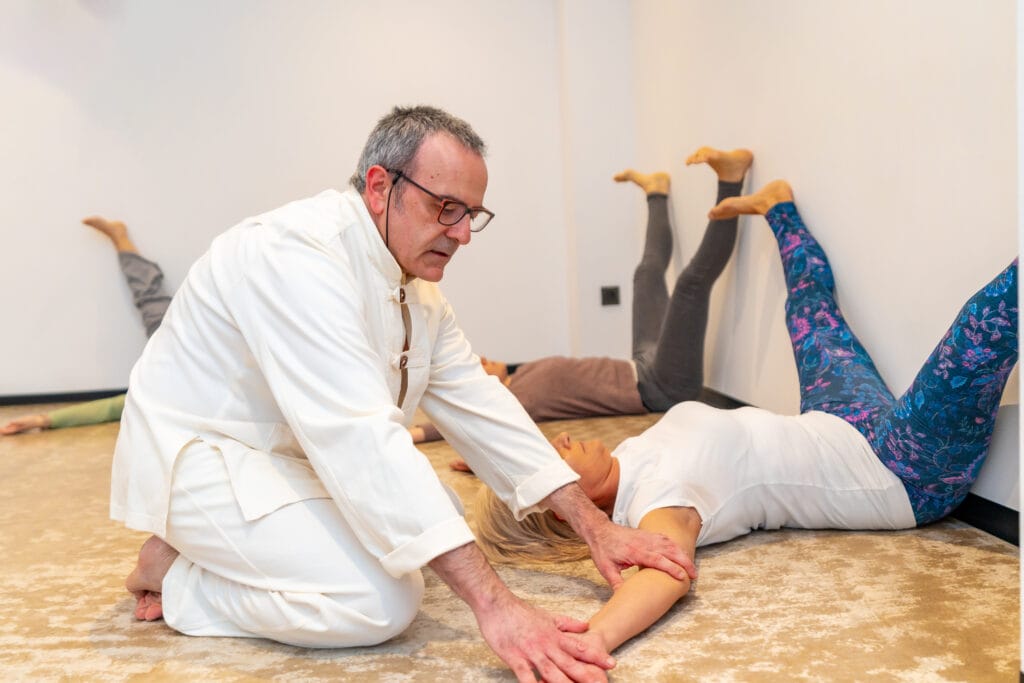
- Numerous are used support elements (blocks, straps, chairs, blankets, walls) to adapt each posture to the anatomy and condition of each person.
- The approach is methodical and pedagogical: it teaches as do, so that, and what to avoid.
- Although the practice can be demanding, it adapts very well to people with specific needs thanks to its careful and precise approach.
Main benefits:
- Improves postural alignment and body awareness
- Strengthens and stabilizes without the need for a fast pace
- It helps to work the body with more care and safety.
- Develop mental focus, patience and discipline
- Allows you to deepen your understanding of each position
Who is it for?
For you if…
- You are detail-oriented and enjoy understanding the "why" behind every move.
- You want to work your body with more care and safety
- You are looking for a demanding but leisurely practice
- You are interested in developing a solid and deep foundation in technique
Kundalini Yoga: Energy, Breathing, and Inner Awakening
Kundalini yoga is a vibrant, energetic and deeply transformative practice.
It is often referred to as the yoga of consciousness, because its focus goes beyond the physical body: it seeks to awaken the energetic and spiritual potential that we all carry within, through breathing, sound, movement and meditation.
The word kundalini It refers to a latent energy that, according to tradition, resides at the base of the spine. This practice aims to activate that energy and raise it through the body's energy centers (chakras), generating an expansion of consciousness.
What does a Kundalini yoga class consist of?
- They work kriyas, which are specific series of physical, breathing and vocal exercises with a specific purpose (for example, to release fear, balance energy or open the heart).
- Breathing is central, especially techniques such as kapalabhati (breath of fire) or anuloma viloma (alternate breathing).
- Included mantras, mudras and meditations with eyes closed and internal focus.
- The class is usually energetically intense, but physically accessible, as it is not based on complex postures.
Main benefits:
- It provides vitality and a sense of balance
- Increases vitality and mental clarity
- Releases emotional and energetic blockages
- Enhances intuition and inner focus
- It promotes vitality and a good mood
Who is it for?
For you if…
- You are interested in working beyond the physical body
- You feel attracted to spiritual or energetic practices
- Do you want to unlock emotions or reconnect with your intuition?
- Are you looking for an intense but different practice from traditional physical training?
Power yoga: strength, endurance, and vitality
Power yoga is vigor, presence and determination.
Originally inspired by Ashtanga yoga, this style was adapted in the 1990s to offer a more free, physical, and accessible practice, without losing the intensity or connection to breath. The result is a class active, challenging and energizing, perfect for those who want to move, sweat and feel more alive than ever.
It doesn't follow a fixed sequence, like Ashtanga, but maintains its dynamic spirit. Power yoga classes often vary depending on the teacher or school, but they all have in common a strong focus on conscious physical work and in strengthening the body.
What does a Power Yoga class consist of?
- Standing postures, balances, fluid transitions and demanding sequences are combined.
- Muscle strength, cardiovascular endurance, and concentration are intensively worked on.
- Conscious breathing (usually ujjayi) accompanies every movement.
- There are usually very few breaks: the goal is to keep the body active and the mind focused.
Although the pace is fast, mindfulness is not lost: it is a demanding practice, but with intention.
Main benefits:
- Improves strength, balance and endurance
- It provides energy and vitality
- Helps release accumulated physical tension
- Strengthens mental focus and discipline
- Ideal for those looking for a complete workout with awareness
Who is it for?
For you if…
- You like a demanding and rhythmic practice
- You want to work body and mind at the same time
- You are looking for a conscious alternative to other forms of intense exercise
- You're in good physical shape and you like a challenge
Yoga Nidra: Guided Meditation for Conscious Rest
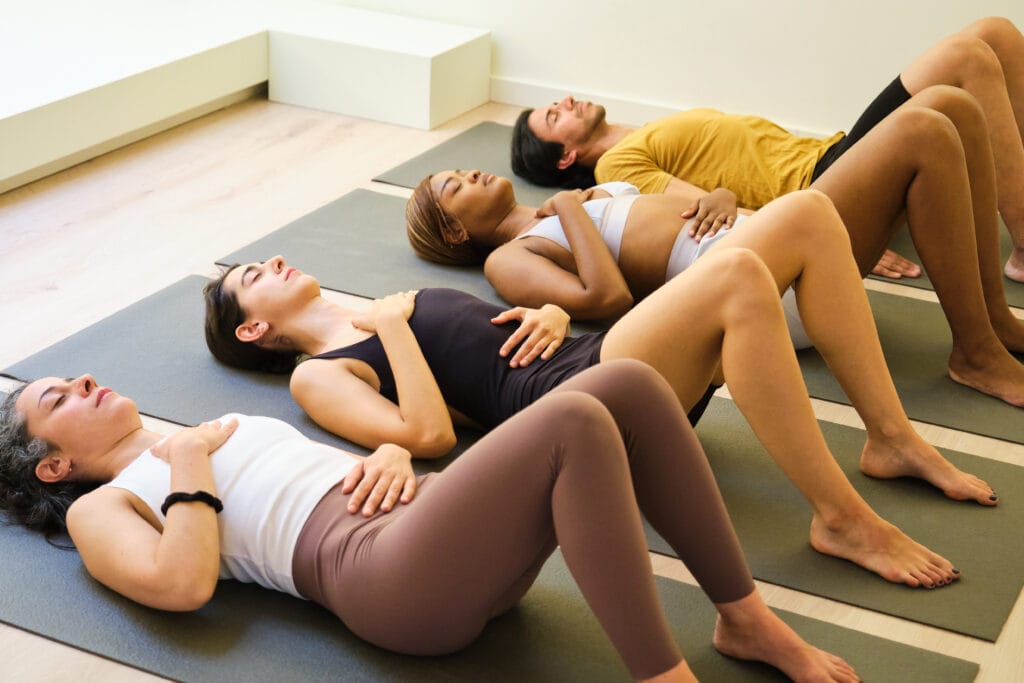
Yoga nidra, also known as "yogic sleep", is not a physical practice but a guided meditation in a state of deep relaxation, which takes you to that space between sleep and wakefulness, where the body rests deeply but the mind remains conscious.
This technique fosters a state of deep calm, allowing the release of deep tensions—physical, emotional, and mental—and access to very subtle levels of perception. It's not about falling asleep, although that can happen, but rather about to rest in a state of effortless attention.
What does a Yoga nidra session consist of?
- It is performed lying on your back in savasana, in complete stillness.
- A guide leads the practice with his voice, taking you through different phases:
- Body scan (consciousness rotation)
- Attention to breathing
- Symbolic or archetypal visualizations
- Sankalpa (positive intention)
- There is no movement or effort: only receptivity.
- The practice usually lasts between 20 and 45 minutes.
Even though the body doesn't move, the experience can be profoundly restorative and revealing.
Main benefits:
- It promotes rest and more restorative sleep.
- It helps to release stress and accumulated fatigue
- Strengthens the ability to concentrate and focus
- It allows you to work at a subconscious level with intention (sankalpa)
- It brings a deep sense of peace and inner connection
Who is it for?
For you if…
- You're looking for real rest, not just "disconnecting"«
- You want to work your mind from a safe and guided space
- You find it difficult to rest or switch off at night
- You are interested in meditating, but you find it difficult to do it in silence or sitting down.
How to choose your style: according to your physical, emotional and vital needs
After learning about the different styles of yoga, it's natural to wonder:
So now, which one do I choose? Which one is "best" for me?
The answer is both simple and complex: the best style of yoga is the one that supports you in the moment you are living.
Your needs may vary depending on the day, the stage of life, or even your emotional or energetic state. Therefore, there is no single ideal practice, but many possible ones depending on what you need to cultivate, release, or awaken.
All roads lead to you
After exploring so many styles of yoga—so different in form, rhythm, energy, and intention—you might think you have to choose "the right one." But here's the most beautiful secret: all paths lead to you.
It doesn't matter if your practice is intense or gentle, if you move or stay still, if you repeat a series every day or just let yourself flow with what you feel. As long as you are present, as long as you listen to your body and your breath honestly, you are already practicing yoga.
Yoga is not a label or a way of moving. It is a way of inhabit you, to return to you again and again, with more awareness, more calm and more truth.
So explore, change, combine, listen. And above all, remember that practice isn't about achieving a perfect pose, but about finding yourself along the way. If you'd like to take that first step with others, you can join our Yoga classes in Granada, where we await you with the level and pace you need.