You've been training well for three weeks straight, and suddenly your calves just won't relax. It's not just muscle soreness anymore: it's a tightness that's still there on Tuesday, Thursday, and the following Sunday. You slow down, stretch more, sleep the same amount, and that area just won't loosen up.
Does this sound familiar? It's the exact moment when most athletes discover sports massage, and also the moment when they ask themselves the three usual questions: does it hurt, when should it be done, and is it worth doing regularly? Let's take it one step at a time.
Sport in a city like Granada is vibrant: you run along the Genil River, cycle towards Sierra Nevada, and walk endlessly through the Albaicín. To meet that level of demand, the body needs recovery and care. sports massage for recovery It's one of the resources that many athletes incorporate into their wellness routine. In this guide, we'll tell you what it offers, who it's suitable for, when to book it, and what the session is like. If you're already ready, you can book directly on our website. sports massage in Granada.
What is sports massage?
It's a type of massage tailored to the needs of those who train. It combines deeper manual work on the muscles, joint mobilizations, and assisted stretching to support recovery and promote muscle well-being after exertion. It's a complementary resource to training, not a substitute for medical treatment: it does not replace professional assessment or management of a diagnosed injury.
Which athletes does it suit?
From what we see daily in the center, it fits with very different profiles:
- Runners: those who prepare for popular races or simply go for a run and end up with tired legs.
- Cyclists and mountain people: road or MTB cyclists, and hikers climbing Sierra Nevada.
- Strength training and gym: when weight training leaves the muscles tense.
- Team sports: basketball, football or padel, with their typical overloads.
When is the best time to schedule a session?
The two most common situations among those who come are, on the one hand, the recovery after exertion —after a hard workout, a race, or a long ride— and, on the other hand, the regular maintenance as part of a routine care plan. Some people also schedule it in the days leading up to a test, or when they notice a particularly strained area. When there is an injury or a supervised recovery process, the massage is always coordinated with the responsible medical or healthcare team.
What is a Quiroesencia session like?
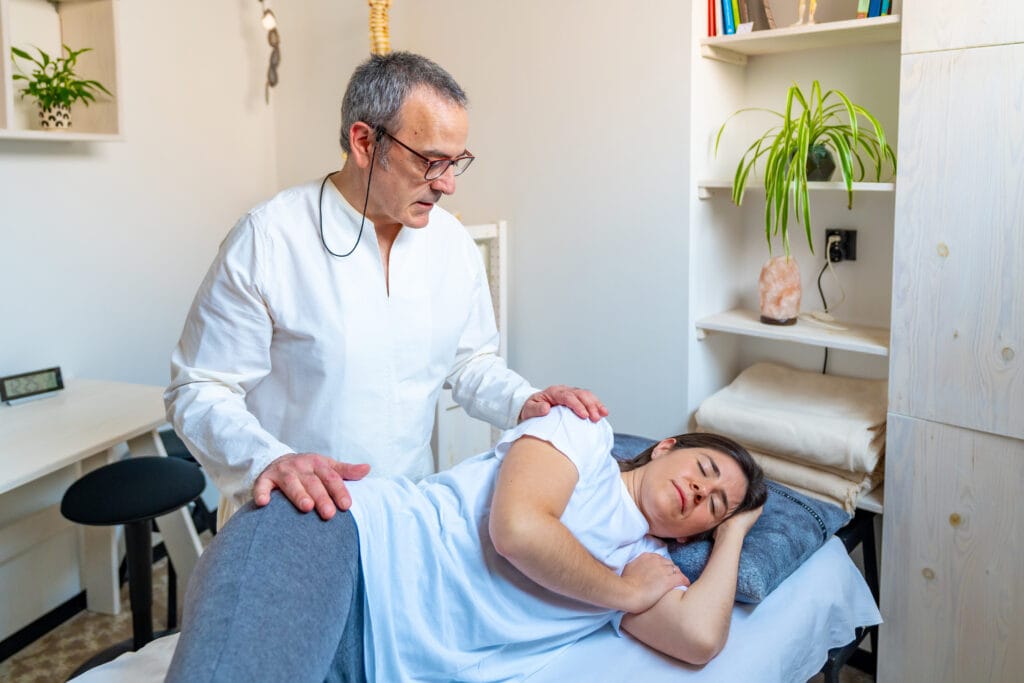
We start by listening to you: what sport you practice, how you've trained, and which areas feel most strained. From there, we work with a deeper pressure on the overworked musculature, accompanied by assisted stretching and mobilizations. The session focuses by zones depending on your discipline, and it can be done combine with muscle-relaxing exercises When there's a specific point that just won't come together. You can see durations and book on the website. sports massage; And if you're unsure between options, compare them with the deep tissue massage It helps you decide.
The techniques and what each one is used for
A sports massage is not a series of strong kneading strokes. It's a combination of techniques, each with a distinct function, and knowing which is which helps to understand why the session progresses as it does.
- Surface landslides. The first few minutes are for warming up the tissue and relaxing the muscles. They may seem insignificant, but they are what make everything else possible.
- Deep kneading. The bulk of the work focuses on the overused muscles. This is where the pressure increases and where we ask you about the intensity.
- Localized frictions. Targeted and slower work on the areas that concentrate the load: calves in runners, quadriceps and psoas in cyclists, adductors in team sports.
- Assisted stretching. You don't do anything; the massage therapist guides the joint. These movements contribute to the feeling of fullness and are usually the most appreciated part at the end.
- Gentle joint mobilizations. Small, careful movements to regain your sense of range. If any movement feels uncomfortable, you can skip it without worry.
Before or after training?
It's the most frequently asked question, and the answer changes quite a bit depending on the time of year.
After the effort
This is the most common and most effective scenario: after a hard workout, a race, or a long ride. Ideally, it shouldn't be on the same day as the maximum effort, but rather the next day or the day after, when the body has already cooled down. At that point, the deep workout is better tolerated and the feeling of rest lasts longer.
Before a test
You should be careful here. A deep massage the night before a race can leave your legs a bit sensitive on the very day you need them to feel their best. If you have a competition, it makes sense to come with at least three days' buffer., And mention it upon arrival so we can adjust the intensity. A more superficial and energizing workout is suitable for the days leading up to it.
As maintenance
The option that yields the best long-term results and is the least used. During peak training seasons, many athletes incorporate it every two or three weeks; off-season, once a month is usually sufficient. It is precisely for this frequency that the [missing word - likely "training frequency" or "training frequency"] exists. four-session bonus.
What athletes usually notice
What people tell us most often when they finish is a feeling of looser muscles and of greater range of motion, in addition to a general rest It goes beyond just muscle mass. We don't promise results—every body responds differently—but that feeling of lightening the load is the most common complaint among those who incorporate it into their routine.
Sports massage tailored to your discipline
Each sport generates different training patterns, so the approach is adapted to the activity. On the blog, we have dedicated guides that can help you take care of your body based on what you practice:
- Massage for cyclists — preventive care and types of massage (pre-competition, post-competition, maintenance) for road or MTB.
- Sports massage for basketball — typical overloads on knees, ankles and shoulders, and manual wellness work.
- Preventive care for musicians — they share with athletes the demand for repetition, with overloads depending on the instrument.
- Recovery for hikers — massage focused on long mountain routes in Sierra Nevada.
Frequently Asked Questions
Is it more intense than a relaxing massage?
Yes. The sports exercise works with deeper pressure and stretching of the overworked muscles. If you're looking for general calming, the [other type of exercise] is a better fit. relaxing massage.
How often is it advisable?
It depends on your training load. Many people use it as regular maintenance and space it out according to how they feel. We'll decide this with you at each visit.
I have a problem, can I come in?
Sports massage at Quiroesencia is a wellness practice, not healthcare. If you have an injury or persistent discomfort, it's advisable to consult a qualified healthcare professional beforehand. Let us know when you book, and we'll tailor the session to what's safe and comfortable for you.
Book your sports massage in Granada
If you train and want to complement your recovery with a pampering break, sports massage is a great option. We offer it at Quiroesencia, in the center of Granada (C/ San Jerónimo 48). Check durations and book on our website. sports massage in Granada, Or write to us via WhatsApp if you prefer us to guide you beforehand.
Related articles
- Sports massage in Granada — book your session
- Massage as a complement to physical exercise
- Yoga and massage for athletes — flexibility and recovery
- Real benefits of deep tissue massage
Sports massage at Quiroesencia is a wellness and relaxation practice. It is not healthcare and in no way replaces the advice, assessment, or treatment of a qualified healthcare professional. For any injury or persistent discomfort, consult your qualified healthcare professional first.