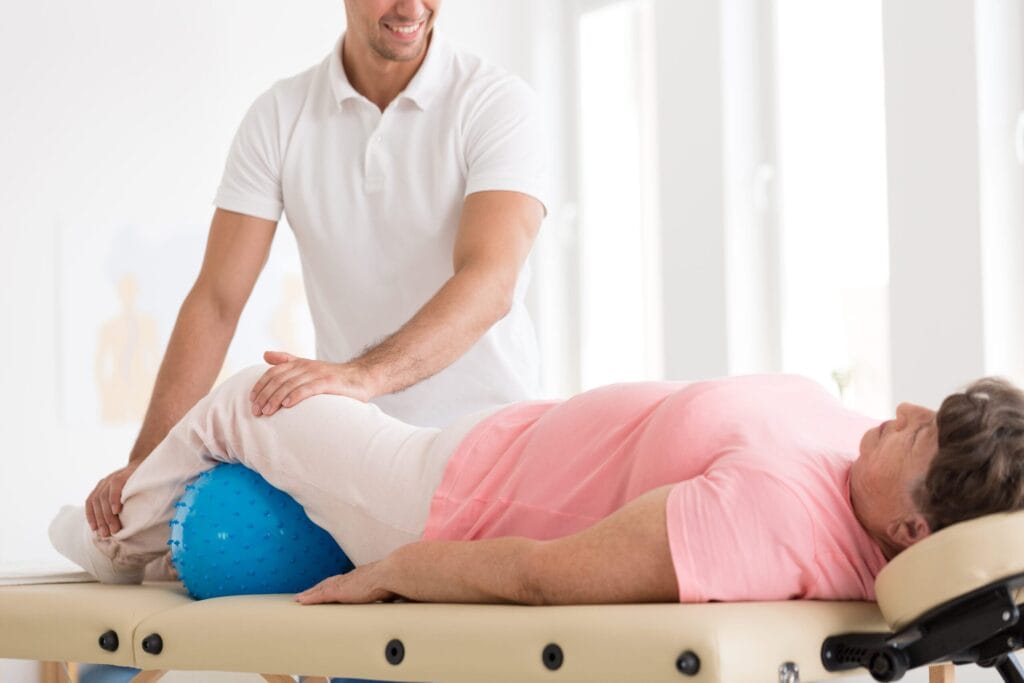
You get home on a random Tuesday and everything hurts. Your back, your neck, your legs. And yet you haven't done anything: you've been sitting, you've been shopping, you've answered emails. No effort whatsoever to justify feeling like this.
Does that sound familiar? It's one of the phrases we hear most often as soon as we walk through the door: «"Everything hurts and I don't know why"». And almost always, when we start working, what appears underneath is not physical overload. It's something else.
The link between the body and emotions
The body reacts to what we feel, even if we don't allow it. When there is sustained worry, haste, or sadness, the body responds: muscles tense, breathing becomes short and rapid, the stomach clenches. This isn't a metaphor or a nice idea; it's what we feel on the treatment table every day.
And it works the same way in reverse. When tension builds up in the body for weeks, the mind begins to feel slower, more irritable, more fatigued. Body and mind are not two separate departments, although we often treat them as if they were: we take the body to the massage therapist and leave the mind to fend for itself.
Why does it hurt even without having made an effort?
When someone comes in saying that everything bothers them for no apparent reason, there are four explanations that are repeated over and over again.
Sustained emotional tension
Prolonged worry puts the body in a state of alert, and a body on alert doesn't let go. Muscles remain partially contracted, especially in the neck, shoulders, jaw, and lower back. This is why some people wake up more tired than when they went to bed.
Repeated postures and gestures
Eight hours in front of the computer, a pillow that doesn't support the neck, the bag always on the same shoulder. These are such small gestures that we don't even register them, and that's precisely why they accumulate. The body adapts as best it can for months, until it finally warns us.
Poorly distributed, one-off effort
This is the most obvious: training hard without stretching, lifting weights without warming up, or working with your body all day. Waiters, healthcare workers, construction workers. Bodies that don't rest even if the person sleeps.
Shortness of breath
It's the least known, yet one of the most common. When we're in a rush, we breathe shallowly and shallowly, barely moving the upper part of our chest. This keeps the diaphragm tense and contributes to that diffuse feeling of fatigue that just won't go away. Many people, mid-session, unconsciously return to slower, deeper breathing. This is often the moment when the body finally gives in.
Mental exhaustion: the unseen burden
Unlike physical discomfort, mental exhaustion isn't something you point to. But it's instantly recognizable: it's that tiredness that a nap can't fix, the feeling of not being able to think clearly, of being overwhelmed without having done anything extraordinary.
We live at a pace where being busy has become the norm: screens, notifications, deadlines, responsibilities. And we rarely give ourselves permission to slow down. The body enters a state of sustained activity, and that activity takes its toll on both fronts at once.
We remember the case of a freelance designer who came to the center with his trapezius muscles as hard as rocks. His work wasn't physically demanding at all: he spent all day sitting in front of a screen. What he needed wasn't just neck work, but a dedicated time each week when there was nothing to fix. For many people, that time is the most valuable part of the session.
Signs your body is asking for a break
These are the most common complaints among those seeking relief. If you recognize yourself in several of them, you've probably been putting off taking a break for too long. And if any of them are persistent or intense, the first step is to consult a qualified healthcare professional.
In the body
- Frequent feeling of tension in the neck, shoulders or back.
- Heavy legs or a "stiff" body when you get up.
- Feeling of pressure in the head at the end of the day.
- A knot in the stomach or uncomfortable digestion during busy times.
- Physical fatigue with no apparent cause.
- Unrefreshing sleep: you go to bed tired and wake up the same.
In the head
- You can't even disconnect in your free time.
- You notice you're more irritable than usual, or you cry more easily.
- A feeling of always pushing the limits, with your mind on fire.
- You have trouble concentrating or making simple decisions.
- Feeling disconnected from your own body.
- The need to always be busy, without allowing yourself to stop.
What happens on the stretcher
Sustained, predictable, and undemanding contact is one of the few stimuli that can lower an alert body's guard without the person having to consciously decide to do so. There's no need to make an effort or intentionally relax: it's quite the opposite; the body loosens up when you stop trying.
In a session with this approach, there are three areas that almost always require attention:
- Cervical and trapezius muscles, which are the great accumulators of everyday stress.
- The diaphragm area, to accompany a deeper breath. When the breath loosens, everything else behind it usually loosens up as well.
- Feet and hands, where a leisurely pace of work has a general calming effect that surprises those who haven't experienced it.
And yes, it's normal to get emotional.
It's worth saying because nobody says it, and then it catches people by surprise: It's not uncommon to get emotional on the examination table. It happens quite often, especially in the first few sessions or during difficult times. Sometimes it's a few discreet tears, sometimes just a long sigh that comes without warning.
There's nothing to explain or apologize for. When your body has been holding on for months and suddenly finds a moment when no one is asking anything of it, it's quite normal for something to loosen up. If this happens to you, your massage therapist won't make a fuss: they'll continue working calmly, or stop if you prefer. It's up to you.
What massage is not
We prefer to be clear about this because promises are often made too lightly in this field. Massage is a wellness practice: it accompanies, supports, and provides a space for calm. It is not psychological therapy, nor does it replace it.
If you're going through a truly difficult time—a sadness that won't go away, anxiety that affects your daily life, something that's stuck inside and won't budge—what you need is a mental health professional. An hour on a treatment table can be a helpful complement and a real respite, but it's not where the problem is solved. We'd rather lose a booking than let someone confuse the two.
A pause is not a luxury
You don't have to reach your limit to deserve some self-care. In fact, those who best maintain their pace are those who stop before they need to, not those who keep going until their body forces them to.
If you recognized yourself in several of the signs above, you can book your directly relaxing massage in Granada, which is the best fit when the overall rhythm is more important than a specific area. If, in addition, there's an area that hasn't yielded for weeks, the deep tissue massage It's the most specific option. And if you're still unsure, write to us explaining how you're getting here and we'll guide you with no obligation.
Related articles
- Relaxing massage: what it is, what it's for and types — the complete cluster guide.
- The role of touch in stress management — why touch calms.
- Massage and improved sleep — when what's lacking is rest.
- Diaphragmatic breathing — to take it home with you.
- Craniosacral massage — an even more subtle job.
The massage sessions at Quiroesencia are wellness and relaxation practices. They are not medical or psychological care and do not replace the advice, assessment, or treatment of a qualified professional. If you are experiencing sustained emotional distress, please consult a mental health professional.